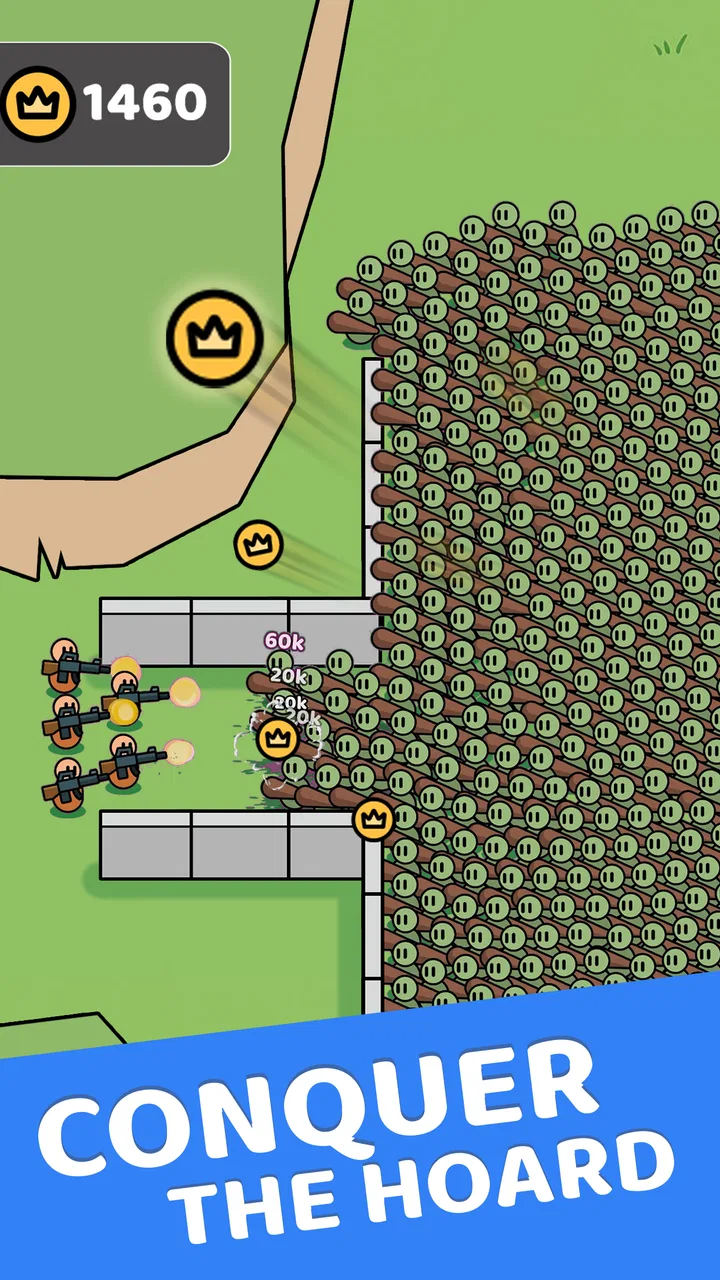
We Are Warriors!
- 4.5
- Rating
- 10.00M
- Installs
- Free
- Price

 Analysis by App-foxy
I spent time with We Are Warriors as a strategy game, but the most useful way to describe it is as a quick battlefield game that can fit around ordinary routines. It is easy to pick up for a short session, yet it still asks you to think about timing, upgrades, and which battle is worth your attention. That makes it a natural candidate for a shared household device, although it is important to treat each player’s progress and spending choices as separate matters.
The basic appeal is straightforward: you guide an army through different stages of history, improve your forces, and try to overcome increasingly difficult opponents. The presentation is more playful than serious, so I never felt as though I was managing a complicated military simulator. Instead, the game turns the idea of evolving through the ages into a compact loop of preparation, deployment, reward collection, and another attempt.
Lessmore UG developed the game, which is free to install and rated for Everyone 10+. It has reached over 10 million installs, while its average score sits at 4.4 from roughly 260 thousand ratings and about 12 thousand written reviews. Those figures suggest a large and generally positive audience, but my experience was more mixed in the useful way: the core loop is approachable and satisfying, while the long-term pace requires patience and sensible boundaries.
You May Also Like

 Blood Strike: 2.5 Anniversary
Blood Strike’s Loadouts Turn Every Drop Into a Tactical Gamble
A close look at Blood Strike’s custom loadouts: how fast access to signature weapons reshapes its battle royale rhythm, rewards preparation, and narrows the gap between fights.

 Pandora - Music & Podcasts
Pandora’s Music Is Easy to Start, but Harder to Recover
Pandora’s strength is its low-effort path from a seed to a station. Its weak spot is how much confidence it asks you to place in connection, setup, and quiet recovery.

 8 Ball Pool
 Is Built on Rivalries, Rematches, and Routine
A close look at the rivalries, rematches, shared routines, and unanswered safety questions that turn a quick pool match into a persistent mobile community.

 Samsung Music
’s Quiet Strength Is Playing What You Already Own
Its reach comes less from spectacle than from dependable access to a personal library. That simplicity is both the app’s strongest retention engine and its ceiling.

 AccuWeather: Weather Radar
AccuWeather Review: A Quick, Clear Forecast for Everyday Decisions
For everyday plans, the best forecast is the one you can understand quickly. AccuWeather makes rain timing, radar, and local conditions easy to act on, with a few trade-offs.

 Hill Climb Racing
Why Hill Climb Racing Still Turns Crashes Into One More Run
A tiny car, a bumpy hill and one more upgrade: Hill Climb Racing keeps resurfacing because its simple chaos makes every near-miss feel personal.
More From Our News Desk



How We Are Warriors Works in Everyday Play
When I think about everyday play, the key choice is not simply whether to start another battle, but what I want to learn from it: a better deployment, a more useful upgrade, or whether my current approach can carry me forward. That makes a short session feel purposeful, especially if I set a stopping point before opening the game. Next, it helps to look at how each attempt gives feedback and shapes the decision to try again.
A good fit for a shared tablet, with one important catch
I can easily imagine this game living on a family tablet or a phone that more than one person uses. A child might enjoy choosing units and watching a battle unfold, while an older player may focus on the order of upgrades and the best moment to spend resources. The controls do not demand the kind of precision associated with a fast action game, so passing the device between people is practical.
The catch is that a shared device is not the same thing as a shared game account. Progress, decisions, and purchases can become confusing when several people play without agreeing on who is responsible for the current run. Before installing it for household use, I would decide whether the game belongs to one player or whether everyone is simply taking turns with the same progress. That small conversation prevents a lot of frustration later.
For a single player, the game works best as a short routine rather than an all-day commitment. I found it easy to play a few battles, improve my army, and put the phone down. That rhythm is useful during a commute, while waiting for an appointment, or during a short break when a large strategy title would feel too demanding.
It is less suitable if you want a deep campaign with a large map, diplomacy, complex economics, or long multiplayer sessions. Compared with traditional strategy games, We Are Warriors keeps the decision space narrow and the action immediate. That is its strength for casual play, but it is also the reason a player looking for a detailed empire simulator may lose interest.
What the early sessions teach you
The opening battles are not difficult to understand. You learn how units behave, how an army grows, and how progress through different eras changes the feel of the battlefield. I recommend resisting the urge to spend every reward immediately. Early resources are more useful when they support a clear plan instead of being scattered across every available improvement.
One of the first practical lessons is that winning is not always about sending everything forward as quickly as possible. I had better results when I watched how the opposing force was developing and treated each deployment as a response rather than a reflex. A cheap unit can be useful for buying time, while a stronger choice may be better saved for the moment when the opponent’s formation is vulnerable.
This creates a small but meaningful layer of planning. The game does not overwhelm you with a long list of menus, yet it rewards attention to the relationship between timing and resources. If you simply tap through every opportunity, you may progress, but you are less likely to understand why one attempt succeeded and another failed.
Setting boundaries before children or guests play
Because the game is free, it is easy to treat installation as the whole decision. In a household, I would also discuss in-app purchases before handing the device to a younger player. Individual items range from $0.98 to $99.99, so the difference between a small optional purchase and a very expensive one is substantial. The game should not be treated as automatically cost-free just because the download itself is free.
I would create a simple household rule: no purchase without asking the device owner first. That rule is more dependable than assuming every player understands the value of digital currency or recognizes when a screen is offering a paid shortcut. It also keeps the game from becoming a source of arguments between siblings or between a child and a parent.
For shared use, I would also set a clear session routine. One person can play until a battle or upgrade is complete, then hand over the device instead of stopping in the middle of a decision. This matters because another player may not understand why resources were saved, why a unit was selected, or why an upgrade was postponed. A short handover explanation makes cooperation possible without turning the game into a family meeting.
There is another boundary worth considering: do not let a younger player assume that a difficult battle must be solved by spending money. The more valuable lesson is to retry, adjust the army, and recognize that a temporary slowdown is part of the strategy loop. That approach makes the free portion more enjoyable and reduces pressure to buy progress.
Coordinating play without taking over someone else’s progress
When I played with another person nearby, the most enjoyable arrangement was not competing for control of every tap. One player could make the broad decisions while the other watched for timing opportunities or suggested when to hold resources. This turned a simple mobile game into a small coordination exercise.
That style works particularly well when players have different levels of experience. A younger or newer player can choose the next unit, while an older player explains why it might be better to wait. The conversation stays connected to what is happening on screen, so it feels more natural than giving a lecture about strategy.
Still, shared play has a limit. If one person always makes the decisions, the other becomes an audience member rather than a player. I would rotate responsibility between battles or between upgrade choices. This is a practical way to preserve the game’s educational value without inventing a separate family mode that the game does not provide.
A useful coordination habit is to announce the plan before acting: save for a stronger improvement, test a cheaper unit, or attempt the next stage. If the result is poor, everyone can identify what changed instead of blaming the person holding the device. This is especially helpful on a shared phone where the game may be opened casually by several people during the day.
Age context and trust
The Everyone 10+ rating gives parents a useful starting point, but age labels do not replace supervision or judgment. The game’s strategy layer can be approachable for younger players, yet the presence of optional purchases means maturity around spending matters as much as the ability to understand the battles.
I would be comfortable recommending it to a child who can follow a no-purchase rule and understands that progress may take time. I would be more cautious with a player who becomes upset when a game slows down or who tends to tap through payment screens without reading them. In that situation, the issue is not the battlefield mechanics; it is the combination of persistence, impulse, and access to the device.
For adults, the rating does not make the game childish. The visual style and compact structure are clearly casual, but the timing decisions can still be pleasant when you want something lighter than a full-scale strategy title. I enjoyed it most when I approached each attempt as a small puzzle rather than expecting a major campaign experience.
Trust also matters between household users. If one person changes the progression plan, spends stored resources, or buys an item, the others should know. A shared device makes those actions easy to overlook. Keeping the game associated with one agreed player is the cleanest option; taking turns on one progression path can work, but only when everyone accepts that their decisions affect the same account or save state.
Where it stands beside other strategy games
We Are Warriors sits closer to quick mobile strategy than to traditional real-time or turn-based games. It gives you immediate battles and a compact upgrade loop instead of a large world to explore. That makes it easier to start than a more elaborate strategy game, especially for someone who finds extensive tutorials, maps, and resource systems tiring.
Compared with idle-focused alternatives, it asks for more active attention. You cannot simply treat the game as a background number generator and expect the same satisfaction. The timing of deployments and the choice of improvements matter, even though the overall system remains accessible.
Compared with competitive strategy games, it is less demanding socially. I did not need to coordinate with a large online group or learn a complicated multiplayer meta to enjoy the main loop. That is a benefit for household play, where people may want a self-contained activity rather than a commitment to other players.
The trade-off is variety and depth. Players who want extensive customization, a broad roster with many distinct roles, or a campaign that constantly changes its rules may find the structure repetitive. The game’s appeal comes from refining a familiar loop, not from presenting a new type of strategy every few minutes.
Small tactics that make the loop more rewarding
My first practical tip is to separate experimentation from serious progression. When you have enough resources for a meaningful improvement, use the next battle to test that choice rather than immediately changing several things at once. If you alter your army, timing, and upgrade priorities together, it becomes difficult to tell what actually helped.
Second, pay attention to failed attempts instead of viewing them as wasted time. A defeat can show that your force is underpowered, but it can also reveal that you deployed too early or used a unit in the wrong sequence. I found that changing one decision at a time produced more reliable progress than repeatedly tapping through the same plan.
Third, do not let the age theme distract from the practical question of efficiency. Moving forward through the eras feels rewarding, but advancement is not automatically the best immediate choice if it leaves your army poorly prepared. Sometimes strengthening the current setup gives a better result than rushing toward the next visual milestone.
Fourth, when playing with a child, ask them to predict the result before the battle begins. “What do you think will happen if we wait?” is more useful than simply telling them what to press. The game’s compact battles make this easy because the consequence arrives quickly enough to connect the prediction with the outcome.
Device requirements and the cost of staying engaged
The game supports devices running Android 8.0 or later, which covers a broad range of phones and tablets. The current version is 1.63.2, so anyone installing it should keep the app updated through the normal store process to use the current release available for their device.
The free entry point is a genuine advantage for testing whether the style suits you. I would install it, play without spending, and decide whether the battle loop remains interesting before considering any optional item. This is particularly important for a household because one person’s enthusiasm should not automatically become a purchase decision for everyone else.
The main cost is not only financial. The game can encourage repeated attempts, and that can quietly expand a short break into a longer session. For personal use, I found it helpful to stop after a clear objective, such as completing a battle or reviewing an upgrade, rather than continuing simply because another attempt was available.
That same approach works well on a shared device. A defined stopping point makes it easier for the next person to know when the phone is free. It also prevents the game from dominating a device that may be needed for messaging, schoolwork, or other household tasks.
Who should install it, and who should skip it
I would recommend We Are Warriors to someone who wants a strategy game that can be understood quickly but still offers decisions about timing and progression. It is a good match for casual players, families willing to coordinate around one device, and experienced strategy fans who want a lighter side game between larger sessions.
I would also recommend it to players who enjoy gradual improvement. The satisfaction comes from noticing that a better deployment order or a more careful upgrade plan makes a difficult stage manageable. If you like retrying a compact challenge and learning from small mistakes, the design has enough substance to hold attention.
I would skip it if your priority is a large strategic sandbox, a story-heavy campaign, or deep player-versus-player competition. It is also a poor choice for a shared household setup where nobody agrees about purchases or progress. The game can be cooperative in practice, but it does not remove the need for clear ownership and communication.
Parents should think about the same question from a different angle: is the child ready to handle optional spending and delayed rewards? If yes, the game can support conversations about planning and patience. If not, choose a game with fewer financial concerns or keep this one limited to supervised play.
My household verdict
After using it as both a personal game and a possible shared-device activity, I see We Are Warriors as a well-balanced casual strategy option with a clear household caveat. Its battles are approachable, its progression gives short sessions a purpose, and its age-based theme makes the journey easy to understand. I liked that it did not demand the time or concentration of a large strategy production.
At the same time, the free label should be read alongside the optional purchases, not separately from them. The broad price range means household rules are sensible, especially when children or guests can access the same device. Progress should also have an agreed owner, because casual turn-taking can become confusing once one player’s choices affect everyone else.
For my own use, I would keep it installed as a quick strategy break and play with a deliberate plan rather than chasing every available reward. For a family, I would introduce it with a no-purchase agreement, a simple handover routine, and permission to stop when the session is over. The best way to enjoy this game is to treat its pace as part of the challenge, not as a reason to spend.
That leaves me with a positive but specific recommendation. We Are Warriors is worth trying if you want compact army strategy, gradual improvement, and an easy entry point on a compatible Android device. It is not the right replacement for a deep strategy classic, and it should not be placed on a shared device without discussing account boundaries and spending first. Within those limits, it offers a friendly way to make a few spare minutes feel like a small tactical decision.
FAQs for We Are Warriors!
01What type of game is We Are Warriors!?
We Are Warriors! is an action-packed role-playing game (RPG) that combines strategic elements with immersive storytelling. Players embark on epic quests, build powerful teams, and battle mythical creatures in a richly detailed fantasy world. The game features both single-player campaigns and multiplayer modes to cater to different play styles.
02Is We Are Warriors! free to play or does it require purchases?
We Are Warriors! is free to download and play, offering in-app purchases for virtual currency, special items, and character upgrades. While the game can be enjoyed without spending money, these purchases can enhance the gaming experience by unlocking additional content and speeding up progress.
03What are the system requirements for installing We Are Warriors!?
The game requires Android 5.0 or later and iOS 11.0 or later. It is optimized for both smartphones and tablets. Players need at least 2GB of RAM and around 500MB of free storage space to ensure smooth gameplay. A stable internet connection is also recommended for multiplayer features.
04Are there any social or multiplayer features in We Are Warriors!?
Yes, We Are Warriors! includes robust social and multiplayer features. Players can join guilds, participate in cooperative battles, and engage in competitive PvP arenas. The game also offers chat functions and leaderboards, allowing players to connect and compete with friends and other players worldwide.
05How does We Are Warriors! ensure player safety and data privacy?
We Are Warriors! prioritizes player safety and data privacy by adhering to strict security protocols. The app uses data encryption to protect user information and complies with global data protection regulations. Players under 13 require parental consent to play, ensuring a safe gaming environment for younger audiences.
Pros
- Engaging storyline with diverse characters.
- Stunning graphics enhance gameplay experience.
- Regular updates with new missions.
- Intuitive controls are easy to master.
- Strong community support and events.
Cons
- Requires constant internet connection.
- In-app purchases can be costly.
- High battery consumption during play.
- Occasional bugs in multiplayer mode.
- Limited offline content availability.

We Are Warriors!
Gallery